
Views: 0 Author: Site Editor Publish Time: 2026-03-09 Origin: Site


Choosing the wrong shower niche size can make a shower feel awkward fast. A horizontal shower niche should fit real bottles, feel easy to reach, and look balanced on the wall. In this article, you will learn how to plan the right size, height, and placement before remodeling or installation.
A horizontal shower niche works best when its size is driven by real use, not just appearance. Most people want a niche that looks clean on the wall but also fits everyday products without feeling cramped or oversized. The most practical way to size a horizontal niche is to think in three dimensions at once: width for side-by-side storage, interior height for bottle clearance, and depth for easy reach. A horizontal layout is wider than it is tall, with moderate depth shaped more by wall framing than by style preference.
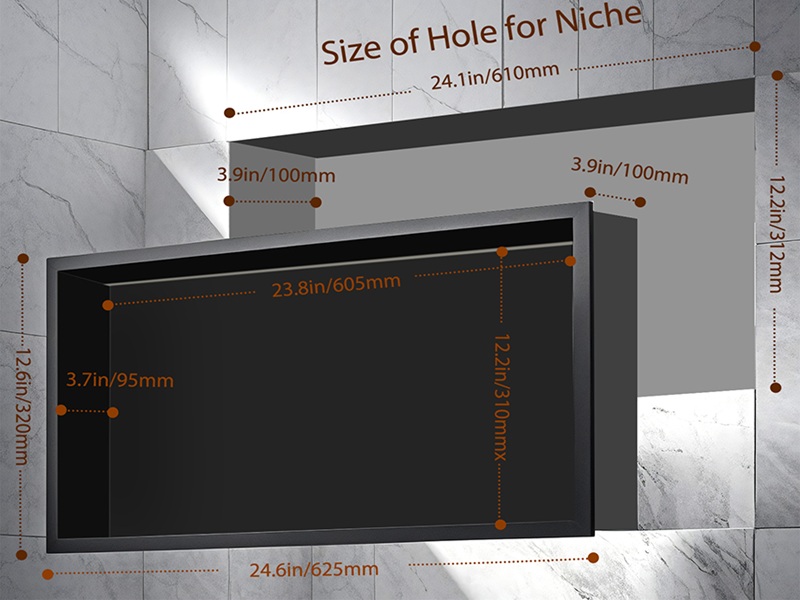
For most projects, a horizontal shower niche performs well when it stays within a practical middle range. In many showers, a width of about 20 to 48 inches offers enough room to place multiple bottles next to each other while still looking proportionate on the wall. A shorter niche can work in a compact shower, but if it becomes too narrow, it loses one of the main benefits of the horizontal layout: easy side-by-side organization. At the other end, a very long niche can dominate the wall visually or require more framing work than expected.
Width should also reflect how the shower is actually used. A single user may only need room for shampoo, conditioner, and body wash. A shared shower often needs more continuous space so products do not crowd each other. The right width is less about copying a fixed number and more about matching the available wall span with the number of products that need to fit comfortably in one row.
Dimension factor | Practical guidance for a horizontal shower niche |
Width | Commonly works best around 20–48 inches, depending on wall span and number of products |
Interior opening height | Usually about 10–14 inches for comfortable bottle fit and hand access |
Depth | Commonly around 3.5–4 inches, shaped by standard wall framing |
Best sizing principle | Size for real bottle storage first, then refine for layout and appearance |
The interior opening height matters more than many people expect. This measurement is not about where the niche sits on the wall, but about how much vertical clearance exists inside the recess itself. In many cases, an inside height of roughly 10 to 14 inches is a practical target for a horizontal design. That range is tall enough for common shampoo and body wash bottles while still keeping the niche visually sleek.
The key rule is to account for tall bottles and the hand movement needed above them. A niche may technically fit a bottle, yet still feel frustrating if there is no room to grab it comfortably or press a pump dispenser without scraping your hand against the top. At the same time, making the opening much taller than necessary can weaken the clean, elongated look that makes a horizontal niche appealing in the first place. A well-sized opening should feel efficient rather than oversized.
Depth is usually the most fixed dimension because it is tied closely to wall construction. In many homes, the practical depth lands around 3.5 to 4 inches, which aligns with common framing depth and provides enough room for standard bottles. This range is usually sufficient for everyday shower products while keeping everything within comfortable reach.
A deeper niche is not automatically better. Once items sit too far back, they become less convenient to grab, and the niche can be harder to keep dry and clean. A moderate depth gives enough clearance for bottles to sit securely without turning the recess into a dark pocket. For horizontal shower niche planning, that balance matters. The niche should store products neatly, but it should also remain easy to use every day.
Getting the installation height right matters just as much as choosing the niche size. A horizontal shower niche can look well proportioned on paper and still feel awkward in daily use if it sits too high or too low on the wall. Most people want to avoid bending too far for shampoo, reaching upward for soap, or ending up with a niche that looks good but feels inconvenient every day. The most useful way to think about shower niche height is to measure from the shower floor to the bottom of the niche, because that point determines how easy it is to place, grab, and return products.
For most standard showers, the bottom of a horizontal niche is commonly installed around 36 to 48 inches from the shower floor, with 48 inches often treated as a practical benchmark. This range places the storage area roughly between chest and eye level for many adults, which makes daily use more natural. Instead of stooping down to reach bottles or stretching upward with wet hands, users can access shampoo, conditioner, and body wash in a more comfortable motion.
A well-placed niche also helps with visual balance. In many showers, a horizontal niche installed within this range feels aligned with the body’s natural reach zone, so it reads as both functional and intentional. If it drops too low, the niche can begin to feel like floor-level storage. If it climbs too high, it stops functioning as easy-access storage and starts behaving more like a display recess. The ideal installation height therefore supports both ergonomics and the overall rhythm of the wall.
Shower setup | Suggested placement logic |
Standard walk-in shower | Bottom of niche often works best around 36–48 inches from the floor |
Adult-focused daily-use shower | Higher end of the standard range usually improves reach and convenience |
Tub-shower combination | Lower placement is often more practical for seated or lower-angle access |
Shared family shower | Placement may shift to suit the most frequent users rather than a fixed standard |
A lower niche position often makes more sense when the shower is combined with a bathtub. In that setup, users may reach for products while seated in the tub or standing in a slightly different position than in a walk-in shower. Placing the niche lower can make the storage more accessible without forcing an awkward reach over the tub edge.
Shared bathrooms are another case where the standard placement may need adjustment. If the shower is used by adults of very different heights, older family members, or children, the best niche height is often the one that serves the primary users most comfortably rather than the one that follows a fixed rule. In practice, this means the ideal placement is not always the most typical one, but the one that fits the people using the space every day.
A horizontal shower niche may look simple in finished photos, but its final size is usually controlled by the wall behind the tile rather than by design preference alone. This is one of the most important planning realities for homeowners: the best niche size is not just about what looks balanced on the wall, but about what the wall can safely and practically allow. Horizontal niches are visually flexible, but they can be more demanding in construction, especially when they stretch wider than a standard opening between studs.
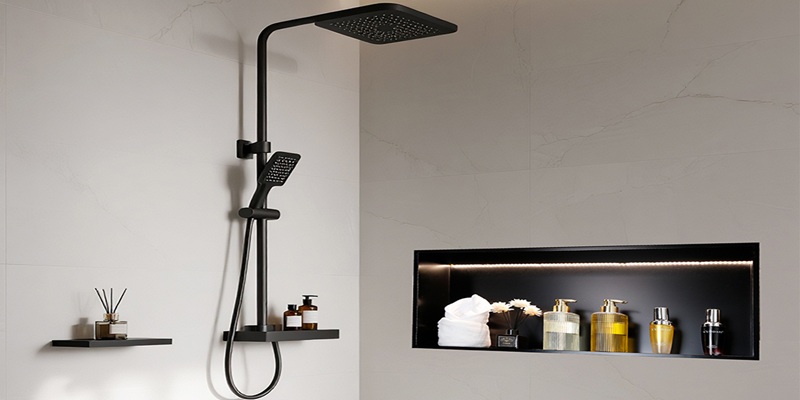
One of the biggest limitations comes from stud spacing. A vertical niche often fits neatly within a single stud bay, but a horizontal niche usually extends beyond that natural opening because its main feature is width rather than height. That means a long horizontal recess may cross more than one stud cavity, which changes the project from a simple cut-in feature to a framing decision. The wider the niche becomes, the more likely it is that the wall will need structural adjustment to support the opening properly.
This is why increasing width is not always a cosmetic choice. In many cases, a wider niche demands additional framing, blocking, or reinforcement so the wall remains stable after part of its internal structure has been interrupted. A niche that seems modest in a design sketch can become more complex once it spans multiple stud spaces. A long horizontal format is still achievable, but it usually requires more careful planning than a compact niche that stays closer to standard wall framing logic.
Even when the wall appears large enough, other hidden conditions can limit niche size or location. Pipes and wiring inside the wall may reduce where the niche can be placed, while exterior walls can restrict how deep the recess should go. Wall depth often determines niche depth, and trying to gain extra depth in some wall types can create moisture-related concerns instead of adding useful storage.
Buildability factor | How it can limit a horizontal shower niche |
Stud layout | Wider niches may cross multiple stud bays and require framing changes |
Plumbing or wiring | Can block the preferred location or reduce available cavity space |
Exterior wall conditions | May limit safe depth and require preserving insulation behind the niche |
Wall structure | Some walls simply cannot support the ideal dimensions without more involved construction |
Because of these constraints, some idealized dimensions do not translate well into real construction. A niche that looks perfect in inspiration photos may not be practical on a wall carrying plumbing lines, located on an exterior boundary, or built in a way that limits recess depth. In real-world planning, buildability often determines whether a size is smart, not just whether it is attractive.
Standard dimensions work well when the wall layout is straightforward and the chosen proportions already fit the tile plan. In those cases, an off-the-shelf size can simplify the project and reduce design friction. Custom sizing becomes the better option when the niche needs to align more precisely with the shower layout, wall span, or tile lines. That decision is less about storing unusual products and more about making the niche fit the architecture of the shower in a way that feels deliberate rather than forced.
A horizontal shower niche can have the right size and height on paper and still look like an afterthought once the tile goes in. What makes a niche feel intentional is usually not one dramatic design move, but a series of small planning decisions that improve alignment, rhythm, and durability. The best-looking niches are not just sized for bottles. They are also coordinated with tile layout, constructed with a clear internal organization, and finished in a way that prevents standing water and long-term wear.
One of the smartest planning steps is to size the niche with the tile layout in mind rather than treating tile as something to solve later. When the niche opening relates well to grout lines and tile proportions, the installation looks cleaner and more deliberate. This does not always mean forcing the niche to align perfectly with every grout line, because exact alignment can become difficult once real-world installation variables enter the process. What matters more is adjusting the niche dimensions early enough to reduce awkward cuts and avoid thin slivers of tile around the opening.
This kind of coordination improves visual balance in two ways. First, it keeps the niche from interrupting the wall pattern too abruptly. Second, it helps the surrounding tile cuts look symmetrical and planned rather than improvised. In a horizontal design, where the niche naturally draws the eye across the wall, those details become even more noticeable. A niche that fits the tile scheme tends to look quieter, sharper, and more expensive, even when the overall design is simple.
Once the outer size is established, the next design decision is whether the niche should read as one continuous opening or be broken into sections. A single uninterrupted niche usually creates the cleanest visual line. It emphasizes the horizontal shape and can make the shower wall feel broader and calmer. This option often works well when the goal is a minimal, modern look or when only a moderate number of products need to be stored.
A divided niche changes the visual rhythm by introducing structure inside the opening. Shelves or sections can make shared storage easier because they separate products instead of letting bottles collect in one long row. They can also help the niche feel more ordered when the opening is fairly wide. The trade-off is that divisions become part of the visual composition, so they should feel intentional rather than purely added for convenience. The choice is less about basic capacity and more about whether the wall should read as one long recess or a more organized built-in feature.
Design choice | Visual effect and practical impact |
One long opening | Creates a cleaner horizontal line and a simpler, more minimal appearance |
Divided niche with shelves or sections | Adds internal organization and gives the opening a more structured visual rhythm |
Tile-aware sizing | Helps the niche feel integrated into the wall rather than inserted afterward |
Water-managed finish | Protects the final look by reducing pooling, staining, and moisture-related wear |
A niche that looks refined on day one can quickly lose that effect if water begins to collect inside it. For that reason, water management is not just a technical requirement. It is also part of the finished appearance. Two details matter most: the base of the niche should slope slightly outward, and the entire recess should be properly waterproofed. That small slope helps water drain instead of sitting under bottles, while dependable waterproofing protects the wall cavity behind the tile.
These measures help preserve both appearance and durability. A niche that sheds water more effectively stays cleaner, resists staining better, and is less likely to develop the kind of damp buildup that makes even a well-designed shower feel poorly executed.
The best horizontal shower niche size and height balance storage, reach, and real wall limits. Smart planning makes the niche fit the space and the user, not just standard numbers. A well-sized niche should feel natural every day and look built into the shower. GuangDong Fiesono Tech Co.,LTD. adds value with practical shower niche products designed for function, clean design, and reliable everyday use.
A: A horizontal shower niche is commonly 20–48 inches wide, 10–14 inches high, and 3.5–4 inches deep.
A: A shower niche is often installed with its base 36–48 inches above the shower floor for comfortable reach.
A: A shower niche size is limited by stud spacing, wall depth, plumbing, wiring, and exterior wall conditions.


