
Views: 0 Author: Site Editor Publish Time: 2026-03-03 Origin: Site


Many vertical designs look good at first, then fail in daily use. A shower niche must fit bottles, suit the wall, and still align with tile. In this article, you will learn how to choose the right vertical shower niche dimensions for width, height, and depth without hurting storage, style, or buildability.
Designing a vertical shower niche is less about picking a random “standard size” and more about working within three practical limits: wall framing, storage needs, and usable depth. A niche that looks good on paper can still fail in daily use if it is too narrow for the wall cavity, too short for tall bottles, or too shallow to hold products securely. For that reason, dimension planning should begin with construction realities and then move toward storage function, not the other way around. The most effective vertical layouts are usually the ones that balance easy installation with enough room for real shower essentials.
Dimension factor | What controls it most | Why it matters in a vertical niche |
Width | Stud spacing in the wall | Determines whether the niche fits cleanly without major framing changes |
Height | Bottle size and storage quantity | Gives vertical niches their main storage advantage |
Depth | Wall thickness and framing depth | Affects bottle stability, reach, and day-to-day usability |
In most cases, width is the first dimension that gets locked in because the niche must fit between existing wall studs. That is why many vertical niches stay relatively narrow compared with horizontal designs. A slimmer niche is often the smartest choice, not a compromise, because it avoids unnecessary structural changes and keeps installation simpler. Instead of widening the opening to chase more shelf space, many homeowners get better results by using wall height more efficiently. This is one reason vertical formats work so well: they create added storage without demanding a wider opening that may interfere with framing.
Height is where a vertical niche becomes truly useful. Unlike a short niche that only holds a few bottles in one row, a taller design can separate products into more practical zones. The right height depends on what the user actually keeps in the shower. Large shampoo or conditioner bottles need more clearance than soaps, razors, or smaller skincare items. Planning height around product mix is more reliable than copying a popular size online, because storage habits vary from one bathroom to another. A vertical niche should be tall enough to improve organization, but not so tall that the space becomes awkward to access or visually overpowering.
Depth is usually constrained by the wall itself, especially when the niche is built into standard framing. That makes it a functional limit rather than a flexible design preference. If the niche is too shallow, bottles may sit too close to the edge or feel unstable. If it is made deeper without regard to wall conditions, the result may create unnecessary construction complications without adding much practical benefit. In most shower layouts, a moderate depth is enough to support everyday bath products while keeping the niche comfortable to reach into and easy to tile cleanly.
The best vertical shower niche size depends less on trend-driven measurements and more on how the shower is actually used. A niche that feels generous in a guest bath may be frustrating in a shared primary shower, while a very tall design can feel excessive if the user only needs room for a few essentials. That is why it helps to match dimensions to bathroom scenario first. When the niche size fits the user count, product volume, and wall area, the result feels intentional rather than oversized or undersized.
Bathroom scenario | Recommended vertical niche dimensions | Best suited for |
Compact shower | 6–12 in. wide × 24 in. high × 3.5–4 in. deep | Single users, guest baths, smaller showers |
Mid-size standard shower | 12 in. wide × 24–30 in. high × 3.5–4 in. deep | Most everyday household use |
Shared bathroom shower | 12–13.25 in. wide × 30–36 in. high × 3.5–4 in. deep | Couples or family showers needing better separation |
Custom vertical niche | Variable, based on tile layout, framing, and storage goals | Non-standard walls, tall bottles, design-driven layouts |
A compact vertical niche works best when the goal is simple, not comprehensive, storage. In a guest bathroom, a secondary shower, or a small stall used by one person, there is rarely a need to create multiple storage zones. A modest niche can hold a shampoo bottle, body wash, and one or two smaller items without making the wall feel crowded. This kind of layout is especially useful when the shower footprint is tight and every visual element needs to stay controlled.
The main advantage of a smaller niche is restraint. It supports daily function without pretending to solve high-volume storage needs. That makes it a better fit for light-use spaces than for busy family bathrooms, where products tend to multiply quickly. In other words, a compact niche is most successful when it is treated as a practical recess for basics rather than the main storage hub for the entire household.
For most homes, a mid-size vertical niche is the safest and most balanced option. It provides enough room for regular toiletries while still fitting naturally into standard wall construction and common tile layouts. This size range tends to work well because it avoids both extremes: it is not so small that bottles feel crammed together, and not so tall that it becomes visually dominant.
In practical terms, this is the dimension range that suits the broadest set of bathrooms. It can usually accommodate everyday products for one or two users, especially if the internal layout is planned carefully. It also tends to be easier to frame, waterproof, and finish cleanly, which matters just as much as raw storage volume. A niche should not only hold products well; it should also look proportionate once tiled.
A taller vertical niche becomes more valuable when two or more people use the same shower. Shared bathrooms usually need more than extra capacity; they need better organization. Greater height makes it easier to divide the niche into functional sections, separating tall bottles from smaller grooming items and reducing the clutter that happens when everything is stacked in one open space.
This type of niche works especially well in primary bathrooms where each user wants a dedicated zone. Rather than widening the niche and increasing framing complexity, going taller often delivers more useful storage with fewer construction compromises. It can also support a cleaner daily routine, since products are easier to see, reach, and keep in order.
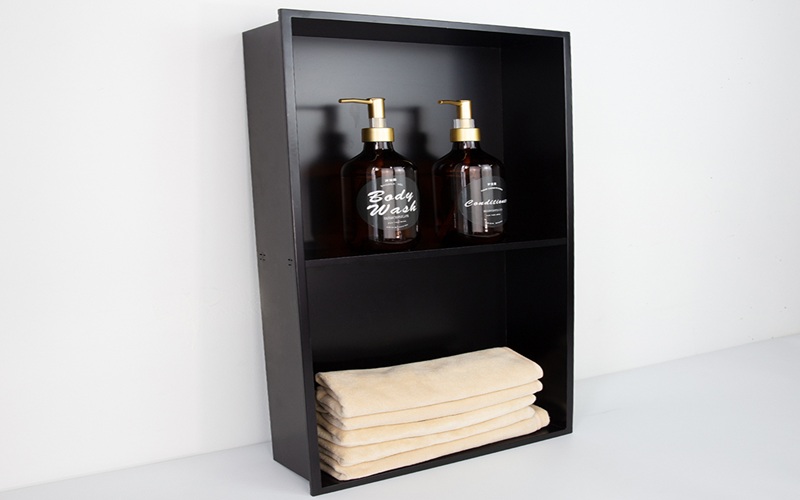
Prefab sizes are practical, but they are still fixed products designed around common conditions. Custom dimensions become the better choice when the bathroom does not follow those assumptions. That may happen when the wall structure is unusual, when specific product heights need to be accommodated, or when the niche must align precisely with a tile layout to avoid awkward cuts.
Custom sizing is also useful when the goal is not just storage, but integration. In these cases, the niche is planned as part of the full wall composition rather than inserted afterward as a standard box. That flexibility can improve both function and finish quality, especially where stock sizes would leave wasted space or disrupt the visual rhythm of the tile.
A well-sized vertical niche can still feel inconvenient if the inside is poorly planned. That is why interior layout deserves its own attention. What matters most is not the outside measurement alone, but how the usable space is divided once tile, shelves, and daily products are taken into account. A niche should be organized around the items people actually reach for in the shower, with enough clearance to avoid cramped access and enough separation to keep the space tidy over time.
Storage zone | Recommended clear purpose | Typical use |
Tall section | Reserved for larger bottles with pumps or caps | Shampoo, conditioner, body wash |
Medium section | Sized for standard daily products | Facial cleanser, shaving cream, smaller bottles |
Small section | Kept shallow in height for compact items | Soap, razors, scrubbers, small accessories |
When planning the inside of a vertical niche, the most useful approach is to think in zones rather than in one uninterrupted cavity. Tall bottles need the most generous clearance, especially if they have pumps or oversized caps that make them harder to remove and replace. A medium-height section works better for standard products used every day, while a smaller compartment is enough for compact items that would otherwise get lost at the bottom of the niche. This kind of internal hierarchy makes the niche easier to use because every product category has a logical place.
The benefit of this approach is practical, not decorative. A tall section prevents full-size bottles from being tilted or squeezed in. A medium section stops common items from competing with larger containers for space. A smaller upper or lower section gives minor items their own spot so they do not clutter the main storage area. In daily use, that difference matters more than a slight change in exterior dimensions.
More shelves do not automatically make a niche more functional. In many cases, too many divisions create narrow compartments that are difficult to use, especially when bottle heights vary. The better strategy is to create shelf spacing based on product types rather than splitting the niche into equal sections. Uneven spacing often works better because shower storage is rarely uniform.
A practical vertical niche may include one taller section for large bottles, one mid-size section for regular items, and one smaller area for accessories. This arrangement supports real habits instead of forcing all products into identical openings. Thoughtful shelf spacing also improves visibility and access, which means the niche stays organized longer and functions more like built-in storage than a simple recessed box.
Even well-chosen vertical shower niche dimensions can fall short if placement and finishing are handled carelessly. A niche may have the right width, height, and depth on paper, yet still feel awkward if it is installed too high, too low, or out of sync with the tile layout. The final impression depends on how comfortably the niche can be reached, how cleanly it integrates with the wall surface, and whether the small construction details protect it from long-term moisture problems. These factors do not replace sizing decisions, but they strongly influence whether the finished niche feels intentional and durable.
Decision area | What to focus on | Why it affects the finished result |
Installation height | Daily reach range and user type | Improves comfort and prevents awkward access |
Tile alignment | Niche edges in relation to grout lines and tile modules | Helps the niche look built-in rather than added later |
Build protection | Slope and waterproofing details | Reduces standing water and hidden moisture damage |
Installation height should be judged by how people actually use the shower, not by a fixed number alone. In a standard walk-in shower used mainly by adults, the niche is usually placed within a comfortable standing reach zone so bottles can be grabbed without bending too low or reaching too high. That makes day-to-day use smoother, especially when the niche holds products used several times in the same shower. If the opening sits too low, users end up stooping repeatedly. If it sits too high, larger bottles become harder to remove safely, particularly when hands are wet.
Placement changes when the shower serves a different routine. In a tub-shower combination, the niche often works better slightly lower because the user may reach it while seated in the tub as well as while standing. In a family bathroom, shared access matters more than ideal placement for one adult. A niche that suits only the tallest user can be inconvenient for children or shorter adults, so the most effective position is often one that favors the main users while staying accessible for the rest of the household. The goal is not geometric perfection, but a placement height that feels natural in daily use.
A vertical niche can look polished or awkward depending on how well it aligns with the tile plan. This is one of the most overlooked parts of niche design because many people finalize the opening size first and think about tile later. In practice, the cleaner approach is the reverse: the niche dimensions should respond to the tile module whenever possible. That does not mean forcing the niche to match every grout line exactly, but it does mean planning the opening so the cuts around it look balanced.
Poor alignment often creates visual problems that stand out immediately after installation. Narrow slivers of tile, uneven joint spacing, or off-center cuts around the niche can make the entire shower wall feel improvised. By contrast, a niche sized with tile in mind usually looks quieter and more integrated. The recess appears to belong to the wall rather than interrupt it. This is especially important with larger-format tiles, where even a small mismatch can become visually obvious. Coordinating the niche opening with the tile layout also helps the installer maintain cleaner lines around the edges, which improves the finished look without requiring decorative excess.
Finishing details are not just cosmetic; they protect the niche from failure. One of the most important is the slight slope at the bottom surface. If the base is perfectly flat or angled inward, water can sit inside the niche instead of draining back into the shower. Over time, that standing moisture encourages staining, grime buildup, and material deterioration. A subtle outward pitch helps keep the niche drier without affecting how products sit on the shelf.
Waterproofing matters just as much. Because the niche is a recessed opening cut into a wet wall, it needs the same level of moisture protection as the rest of the shower enclosure, and often more careful treatment at corners and transitions. The membrane, seals, and finished surfaces must work together so water does not move behind the tile. When these details are handled properly, the niche remains easy to maintain and structurally reliable rather than becoming a hidden weak point in the shower wall.
The right vertical shower niche dimensions depend on wall structure, storage needs, interior layout, and finish quality. A practical shower niche should match real daily use, not just look large on paper. GuangDong Fiesono Tech Co.,LTD. delivers value with well-designed shower niche products that support efficient storage, cleaner installation, and a more polished bathroom result.
A: A vertical shower niche is commonly 12 inches wide, 24 to 36 inches high, and 3.5 to 4 inches deep.
A: A shower niche is often sized around standard stud spacing, so 12 inches is a practical width in many framed walls.
A: The best shower niche height depends on bottle sizes and user count, but 24 to 36 inches suits most projects.
A: A custom shower niche works better when tile alignment, unusual wall conditions, or specific storage requirements matter.


